


Carbon footprint refers to the total impact of greenhouse gas emissions generated directly and indirectly as a result of the activities of a person, product, service, or organization. Many of the things we use in our daily lives have an invisible carbon story. From the coffee we drink in the morning to the means of transportation we use to get to work, from the clothes we wear to a product we order online, the decisions we make are connected to different amounts of energy, raw materials, production, and transportation.
When we hold a product in our hands, we usually see only its final form. We may see the fabric of a T-shirt, the screen of a phone, or the wood of a chair; however, we often do not think about where the raw material of that product came from, how much energy was used during production, or how many kilometers it traveled before reaching us. Yet the environmental story of a product does not begin in the store or in our home. The process that begins with raw material extraction continues through production, processing, packaging, transportation, use, and the end of the product’s useful life. The concept of a carbon footprint aims to make exactly this invisible impact more understandable.
Today, we increasingly encounter carbon footprints in companies’ sustainability reports, product design, energy policies, logistics planning, and consumer communication. The main reason for this is that global greenhouse gas emissions are still at very high levels. According to the International Energy Agency, global energy-related CO₂ emissions increased by 0.8% in 2024, reaching 37.8 billion tonnes. During the same period, the expansion of low-emission technologies such as solar and wind energy, nuclear energy, electric vehicles, and heat pumps contributed to preventing approximately 2.6 billion tonnes of additional annual CO₂ emissions.*
When these two figures are considered together, an interesting picture emerges. On one hand, energy systems and technologies are transforming, while on the other hand, global emissions continue to increase. Therefore, the carbon footprint discussion is not only limited to producing cleaner energy. How much energy and material we use, how long we use products, and how long we can preserve value within the economic system are equally important.
UNEP’s 2025 Emissions Gap Report also states that if current policies continue, the world is on a pathway toward approximately 2.8°C of warming this century.* Even if countries’ current climate commitments are fully implemented, the estimate remains at approximately 2.3–2.5°C. For this reason, understanding the carbon footprint is not merely a concept used in sustainability communication; it is an important tool for us to see where and how we need to change.
What Exactly Does Carbon Footprint Measure?
When we talk about carbon footprint, the first gas that naturally comes to mind is carbon dioxide, or CO₂. However, carbon footprint does not only consist of carbon dioxide emissions. Methane, nitrous oxide, and certain fluorinated gases also contribute to climate change by trapping heat in the atmosphere. Because each of these gases has a different impact on the climate, a common measure is used in calculations: carbon dioxide equivalent, or CO₂e.
When we see that a product has a carbon footprint of 20 kilograms of CO₂e, this does not mean that exactly 20 kilograms of carbon dioxide were emitted during production. It means that the total climate impact of different greenhouse gases has been converted into carbon dioxide equivalents and expressed in a common unit. The most important benefit of this measurement is that it makes very different activities comparable. Electricity use, fuel consumption, logistics, raw materials used in production, or the use phase of a product can generate emissions from different sources. Evaluating these through a common measure allows us to see where the total impact is concentrated.
One of the most widely used frameworks for calculating corporate carbon footprints is the Greenhouse Gas Protocol (GHG Protocol). This approach evaluates companies’ emissions in three main groups:
Scope 1, Scope 2, and Scope 3. Scope 1 covers direct emissions from sources owned or controlled by the company; fuel used in company-owned vehicles or combustion processes in a factory can be examples. Scope 2 refers to indirect emissions arising from the production of electricity, heat, or similar energy sources purchased by the company. Scope 3 covers other indirect emissions across the company’s value chain; it includes a wide range of areas, from purchased raw materials and logistics to employee travel, the use of sold products, and the end of their useful life.
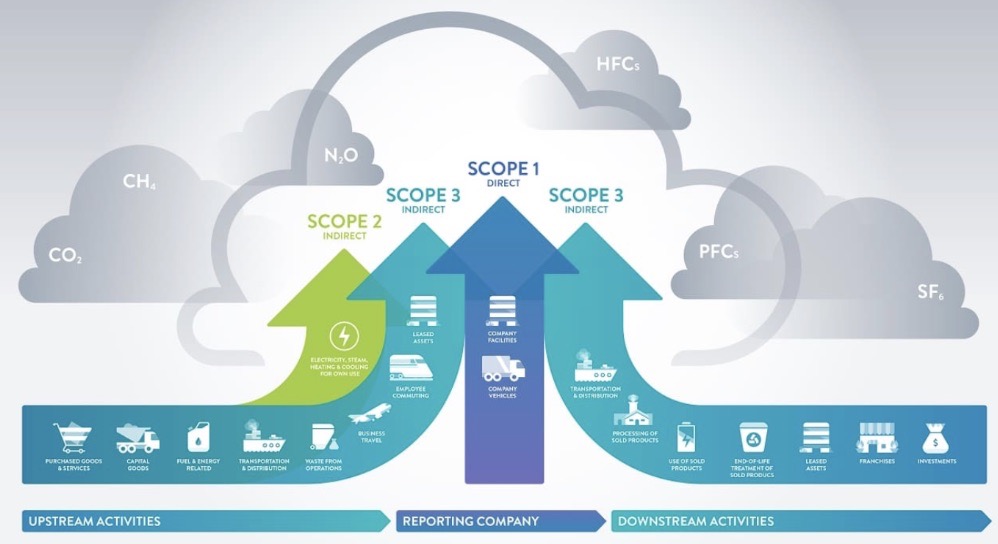
This distinction may seem like a technical reporting system at first glance, but it provides a very practical benefit for companies’ sustainability strategies. A company may have reduced energy consumption in its offices; however, if the majority of its total carbon footprint comes from the production of the raw materials it purchases, focusing only on office electricity will not be enough.
Similarly, if an organization that has converted its vehicle fleet to electric vehicles has its main source of emissions in the use phase of its products, the largest area of transformation may lie elsewhere. Therefore, the purpose of calculating a carbon footprint is not merely to obtain a large or small number at the end, but to see where the impact occurs and set the priorities accordingly.
When comparing the carbon footprint figures of two companies or two products, attention should also be given to the calculation method used. One assessment may take into account only emissions at the production facility, while another may include the entire life cycle from raw materials to the end of the product’s useful life. Likewise, the data sources, emission factors, and calculation boundaries used can also change the results. Although a carbon footprint may appear to be a single number, the processes behind that number are at least as important as the result itself.
Where Does a Product’s Carbon Story Begin?
Let us consider a garment. Before the product reaches a hanger in a store, it may have passed through many stages in different geographies. Fiber is produced, turned into yarn, the fabric is woven or knitted, dyeing and finishing processes are carried out, garment production is completed, the product is packaged, and finally it is transported to the store or consumer. During use, it is washed, dried, and eventually reaches the end of its useful life.
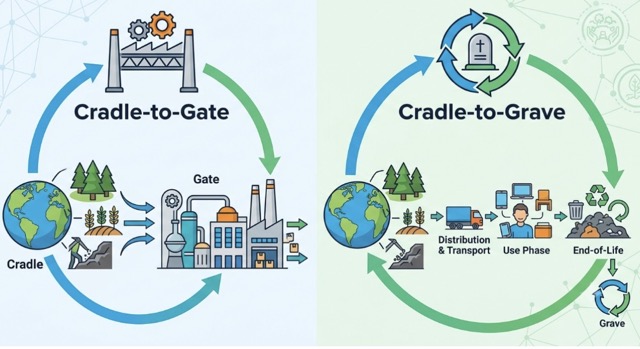
Therefore, a product’s carbon footprint does not only consist of the energy consumed on the production line. In the Greenhouse Gas Protocol’s product approach, product life cycle emissions can also be considered from a Cradle-to-grave perspective covering stages such as raw materials, production, transportation, storage, sales, use, and disposal. By the time the product reaches us, a large part of its environmental story has already taken place, and therefore looking only at the final use stage is not enough to understand the total impact.
The textile sector is a very good example for seeing this. The type of material used in a garment, how it is produced, which energy sources are used, dyeing and finishing processes, transportation distance, and how the consumer uses the product can all change the total environmental impact. Polyester is a widely used material in the textile sector because of its durability and ease of production; however, it is largely derived from fossil resources and requires energy to produce. In addition, synthetic textiles have other environmental impacts outside the carbon footprint, such as microplastic release during washing. For this reason, classifying a material as “good” or “bad” based only on its carbon footprint may not be sufficient.
The same applies to different materials. Cotton may be important in terms of water footprint, metal production may require high amounts of energy, and plastic may be associated with fossil resources.
Rather than evaluating sustainability through a single indicator, different environmental impacts need to be considered together. At this point, the period of use of a product also becomes particularly important. If a certain amount of energy and raw material has been used to produce a product, using that product for a long time means benefiting for longer from the value created during production. Replacing a product that is still functional simply because a new model has been released or a trend has changed may increase the need to produce a new product.
The European Union’s Ecodesign for Sustainable Products Regulation approach also draws attention to considering issues such as durability, reusability, repairability, resource efficiency, and carbon or environmental footprint together. The regulation also aims to make information such as a product’s durability, repairability, recyclability, and, in some cases, carbon footprint more visible through the Digital Product Passport approach.*
The Connection Between Consumption, Textiles, and Carbon Footprint
When discussing the carbon footprint, it is easy to focus on the production processes. Factories, power plants, and logistics vehicles are visible sources of emissions. However, behind the production side lies consumer demand. When we purchase a product, we indirectly demand not only the product itself, but also the raw materials, energy, packaging, and transportation required for that product.
This does not mean that all responsibility belongs to the consumer. A person’s choices are shaped by the transportation infrastructure of the city they live in, the energy mix of the electricity system, the products available on the market, economic conditions, and companies’ design decisions. For example, the options of a person living in a place without public transportation are not the same as those of someone living in a city with strong transportation infrastructure. Therefore, reducing the carbon footprint is related to both individual behavior and system design.
The fashion sector is one of the areas where this relationship is most visible. Rapidly changing trends, low prices, and constantly renewed collections can shorten the perceived useful life of products. Even if a garment is still physically usable, it may feel “old” because the trend has changed. In this case, the environmental impact arises not only from how the product is produced, but from the simultaneous acceleration of production and consumption.
This shows us that raw materials and energy are used even before a product is purchased by the consumer. If the product is never sold or if surplus production directly becomes waste, we lose not only the material but also the potential value that could have been created by the resources used in producing that material. At this point, the carbon footprint goes beyond being merely an emissions calculation tool and becomes an indicator that allows us to see the loss of value.
The same idea applies to the consumer’s wardrobe. When a garment is used only a few times and then discarded, the period of use provided by the energy and raw materials used in producing the product remains quite short. In contrast, using the product for longer, repairing it, sharing it, or passing it on to another user through a second-hand system can extend the product’s functional life.
This idea also applies to products outside fashion. Extending the useful life of furniture, electronic devices, bags, or household goods may delay the need for new production. Of course, there may also be exceptions. Replacing a very old and energy-inefficient device with a more efficient model may, under certain conditions, reduce the total impact during the use phase. For this reason, rather than a single universal rule in sustainability, we need an approach that evaluates the entire life cycle of the product.
Waste Has a Carbon Story Too
It is wrong to think that a product’s environmental impact ends when it goes into the trash. Instead, a new journey for the waste begins; it must be collected, transported, sorted, processed, and eventually recycled or disposed of. All of these processes use different amounts of energy and resources.
This does not mean that recycling is harmful. Compared with the production of virgin raw materials, recycling can provide significant environmental advantages for many materials. Instead of completely breaking down a product and turning it back into raw material, continuing to use it while preserving its existing function may require less processing in some cases. If a suitable material can be repurposed for another use, it can remain within the system without being broken down.
This is where the logic of the “waste hierarchy” becomes important. Approaches such as prevention, extending useful life, reuse, and then recycling show that a single solution is not always the best option in every situation. Another issue affecting the carbon story of waste is contamination. When clean materials become contaminated with different substances, additional washing, sorting, or processing may be required for recycling, and in some cases the material may become impossible to recover entirely. The ability to make use of clean materials with less additional processing can provide advantages not only economically, but also in terms of energy and resource use.
For this reason, it is not correct to approach the discussion of reducing the carbon footprint simply by saying “let us recycle more.” At the same time, we need to design systems in which products and materials retain their value for as long as possible. At this point, the main question is not only how we will manage the material once it becomes waste, but also whether we are questioning why it becomes waste so quickly in the first place.
How Do the Circular Economy and Upcycling Approach the Carbon Footprint?
We can summarize the traditional linear production model quite simply: extract the raw material, manufacture the product, use it, and eventually discard it. In this model, producing new products continuously creates demand for new raw materials and energy, while the circular economy tries to keep the value of products, components, and materials within the system for as long as possible. For this, different methods such as durable design, repair, reuse, sharing, remanufacturing, upcycling, and, where appropriate, recycling need to be considered together.
From a carbon perspective, the striking aspect of the circular economy is that it does not only aim to use lower-emission energy, but also questions how much new production we actually need. For example, let us consider a company’s surplus production fabrics. The fabrics may be clean and usable but no longer needed for their original production purpose.
While in a linear system these materials may easily be seen as waste, the circular approach asks different questions: Can they be reused in the same production process, used for another product, become raw material for another organization, or be transformed into a different product through design? Upcycling is one of these options.
In Reppatch’s definition of upcycling, upcycling is described as transforming waste or unwanted leftover products into new products with higher value or quality through design. In recycling, the material is generally broken down and turned back into raw material, whereas in upcycling, a new function and higher value are given to waste or surplus material through design. For example, completely separating an unused denim fabric into fibers and producing new yarn may be part of a recycling process, while cutting and redesigning the same fabric into a bag or another product may be an example of upcycling.
The potential advantage of this process in terms of carbon footprint is that it can reduce the need for new raw materials. However, upcycling is not “zero-carbon” or “carbon-free”; energy may still be required to transport, clean, sew, or otherwise process the material. Therefore, when explaining the environmental value of upcycling, it is necessary to adopt a more realistic approach rather than exaggerated claims: preserving the value of existing material and reducing the need for new raw materials as much as possible.
Carbon footprint does not have to answer only the question “how many kilograms of CO₂e did we emit?”; it also allows us to ask new questions about product design and resource use. Could the product have been more durable, could it have been repairable, could its parts have been replaceable, could surplus production materials have been used in another area, or could it have been designed to be more easily separated for recycling at the end of use? Questions like these help us to think about the carbon reduction not only during the production stage but starting from the design table.
The fact that the European Union’s new product policies consider criteria such as durability, reusability, repairability, and environmental footprint together also shows that this thinking is increasingly entering the policy sphere. Under the Digital Product Passport approach, consumers are expected to be able to access more transparent information in the future about durability, repairability, recyclability, product composition, and environmental impacts for certain products. In this way, not only the purchase price of products but also the environmental value they carry throughout their useful life may become more visible.
Where Should We Start to Reduce the Carbon Footprint?
One of the most common mistakes in reducing the carbon footprint is assuming that there is a single sustainability checklist that can be applied to everyone. Yet the emissions profiles of a steel producer, a textile brand, a software company, and a logistics company may be completely different from one another. Therefore, meaningful carbon reduction begins first with understanding the company’s own impact.
Measurement is important here. When Scope 1, Scope 2, and, as far as possible, Scope 3 sources are evaluated, companies can identify their largest sources of emissions. Priorities can then be set in areas such as energy efficiency, low-emission energy, logistics optimization, material selection, product design, and supplier transformation.
Small and visible sustainability actions should not replace major sources of emissions. Reducing single-use products in the office or providing recycling bins for employees may be meaningful practices; however, if most of a company’s total emissions come from the raw materials it uses or the use of its products, it would not be realistic to say “we solved our carbon footprint” through office practices alone. A good sustainability strategy should always target not the most visible action, but the area where the greatest impact occurs.
All of this shows that the carbon footprint discussion is not only a matter of technology. We need cleaner energy; however, we also need longer-lasting products, better designs, more effective public transportation, transparent supply chains, and more circular production systems. On the individual side, rather than trying to be perfect at sustainability, a more practical approach needs to be adopted. It is not realistic to calculate dozens of environmental indicators for every purchasing decision, but it is possible to make a few basic questions a habit, such as “Do I really need this?”, “Do I already have a similar product?”, “If I buy it, can I use it for a long time?”, “Can it be repaired?” or “Is there a second-hand option?”
The purpose of these questions is not to blame the consumer, but to add another perspective to the existing habit of evaluating purchasing decisions only through price and novelty. Completely eliminating the carbon footprint is not realistic for most people, products, or organizations. The main goal should be to first understand where the impact occurs, reduce the emissions that can be reduced, and make production and consumption systems lower-carbon in the long term.
However, this transformation should not consist only of producing the same amount of products with cleaner energy. How long we can preserve the value of the products and materials we have already produced is also an important part of this transformation. When a product is replaced before it reaches the end of its useful life, we lose not only the physical object, but also the potential period of use of the energy and raw materials used in its production. Similarly, when surplus fabric that is clean and usable becomes waste, existing value that could be used for a new product leaves the system.
For this reason, one of the most important designing questions for a low-carbon future is not only “How can we produce this in a more environmentally friendly way?” Alongside this, we also need to ask, “How long can we use this without having to produce it again?”